Signet Ring Guide: Shapes, Engraving and Custom Design
A signet ring is a ring with a flat top — oval, round, cushion or rectangular — that's engraved with initials, a monogram or a family crest, or set with a stone. It was originally used to press a seal into wax. Today it's a personal piece for men and women, usually made in 14K or 18K gold.
What is a signet ring, and where does it come from?
Signet rings are among the oldest kinds of jewelry. In the ancient world a personal seal worked as a signature: you pressed it into something soft — clay, later wax — to authorize a document or close a letter. Hebrew sources use the ring as a symbol of authority too: Pharaoh hands his ring to Joseph, and in the Book of Esther the king gives his ring to seal decrees. In Hebrew, the words for “ring” and “seal” are closely tied for exactly that reason.
In Europe, signets bearing a family crest were handed down through generations and became a mark of lineage. Hardly anyone seals letters in wax now, but the idea survives: a ring that carries an identity — a name, a family, a date or a symbol that matters to you. That is also why a signet is such a popular bar mitzvah gift and milestone present.
Which signet ring face shape should I choose?
The face — the flat top — is the first decision, and it affects both the look and how much room you have to engrave.
| Shape | Character | Suits | Best engraving |
|---|---|---|---|
| Oval | The classic: balanced and flattering on most fingers | Men and women, everyday wear | Initials, monogram, family crest |
| Round | Soft and modern | Slim fingers, the pinky | A single letter or circular monogram |
| Cushion | A square with rounded corners; vintage feel | A slightly bolder look | Two or three letters, a symbol |
| Rectangle | Crisp and geometric; reads more masculine | Longer fingers, a minimal look | A short name, a date, letters in a row |
Size matters too. A small face (roughly 8–10 mm) looks delicate and suits a pinky or a women's signet; a face of 12–15 mm or more is a clear statement. Keep the finger's width in mind — a face that overhangs the finger feels clunky.
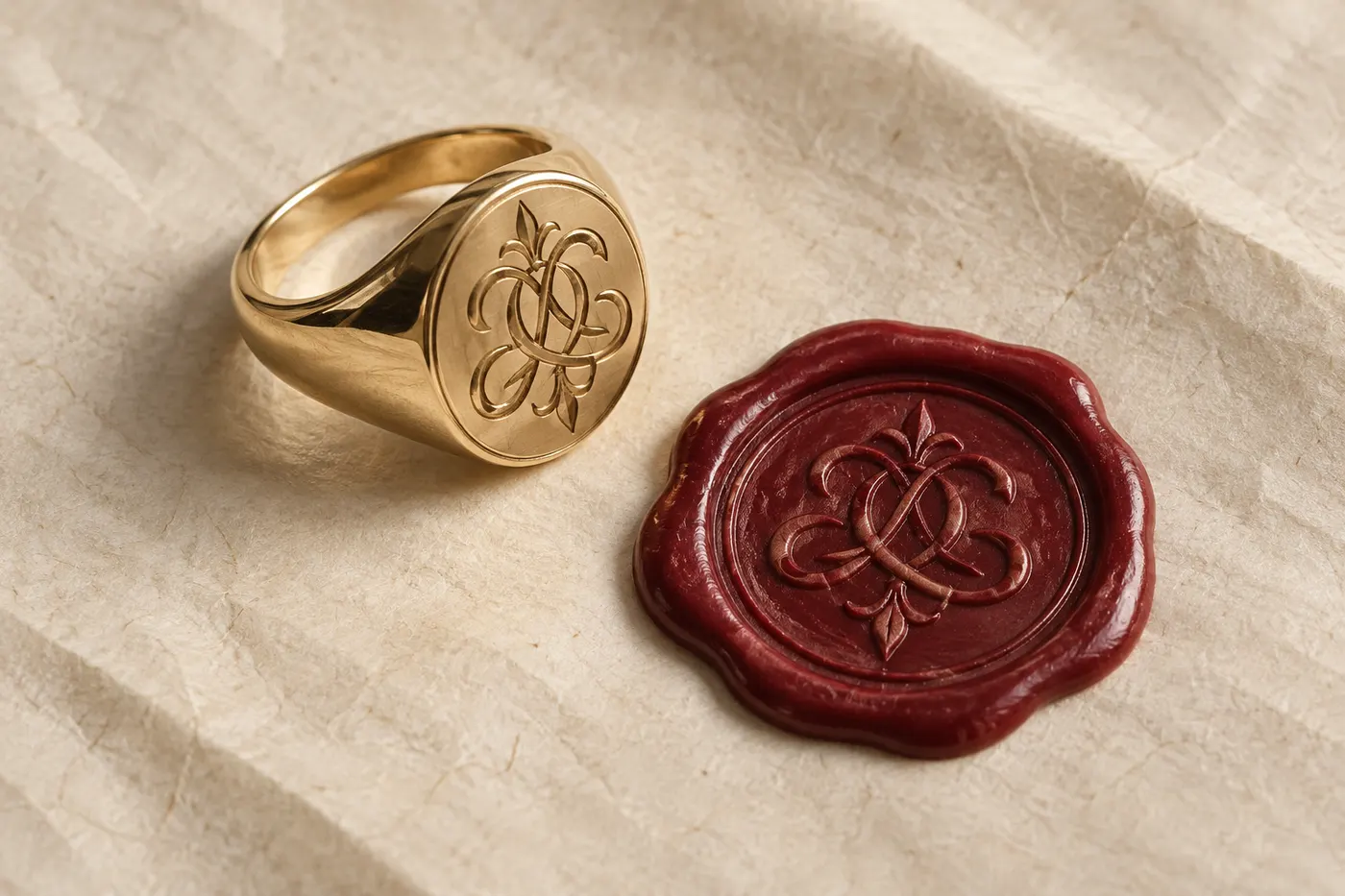
What engraving options are there for a signet ring?
- Initials — one to three letters, in English or Hebrew. The most popular and simplest choice.
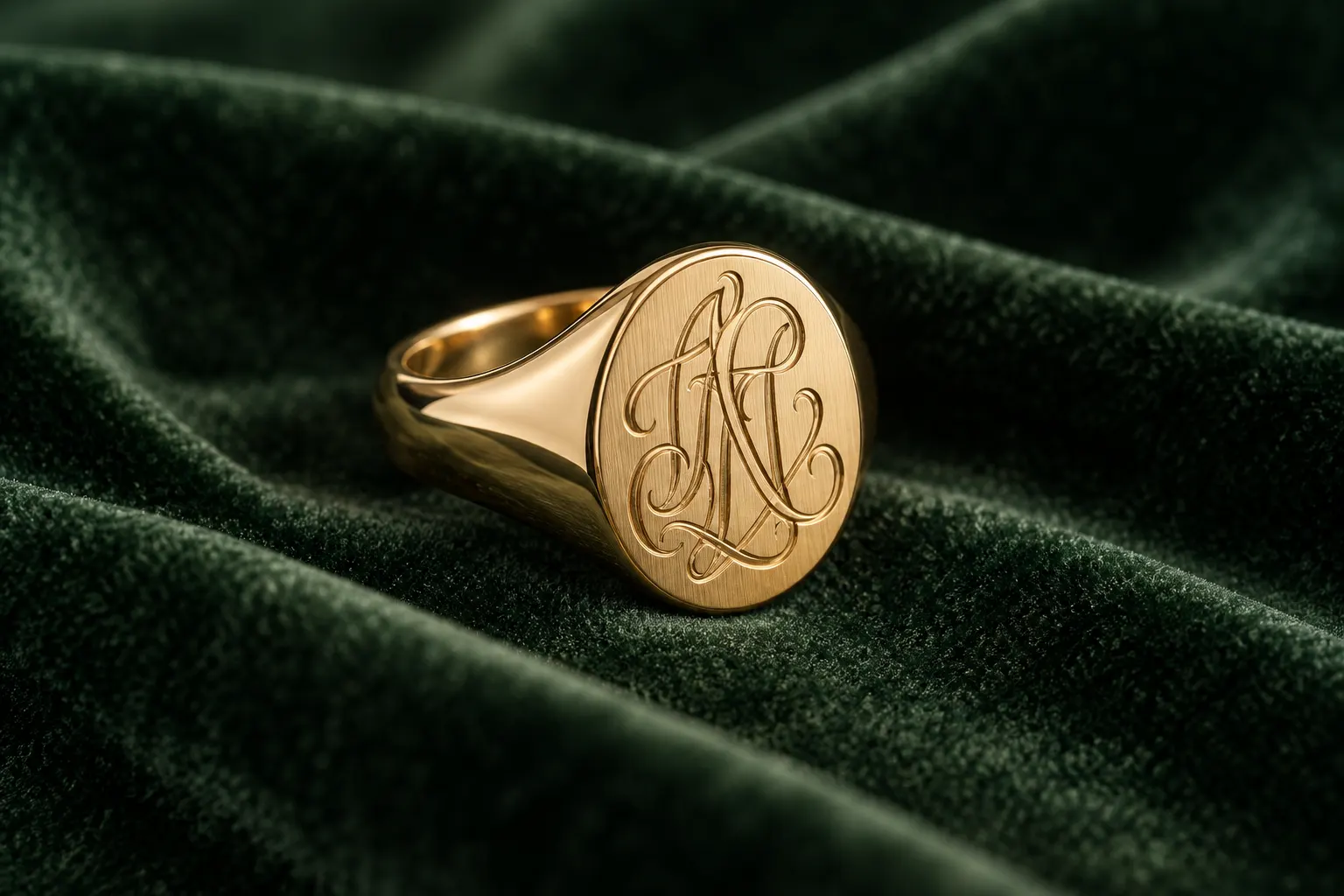
- Monogram — letters interlaced into a single emblem, usually with the surname initial larger in the center and first-name initials on either side.
- Family crest — a heraldic crest, a city emblem, or a family symbol you invent yourselves (an animal, a tree, a tool). Needs a larger face so the detail reads.
- Flat engraving — reads directly when you look at the ring. Great for letters, names and clean line work.
- Reverse (seal) engraving — deep, mirror-image engraving, so pressing the ring into wax leaves a correct, raised impression. This is the traditional technique, and it needs a thick enough face.
You can combine them: engrave the face and add a date, a short phrase or a name inside the band. For more ideas, see our jewelry engraving ideas.
How do stone-set signet rings work?
Instead of engraving, you can set a flat stone that fills the whole face — dark stones like black onyx or a deep blue stone are a traditional, striking choice. Another option is a small diamond flush-set in the center of the face, or a diamond beside an engraved initial. Keep in mind that a stone face can't be deeply engraved the way gold can, and it's more exposed to knocks. If you're considering a diamond, our 4Cs guide will help.
Signet rings for men and for women
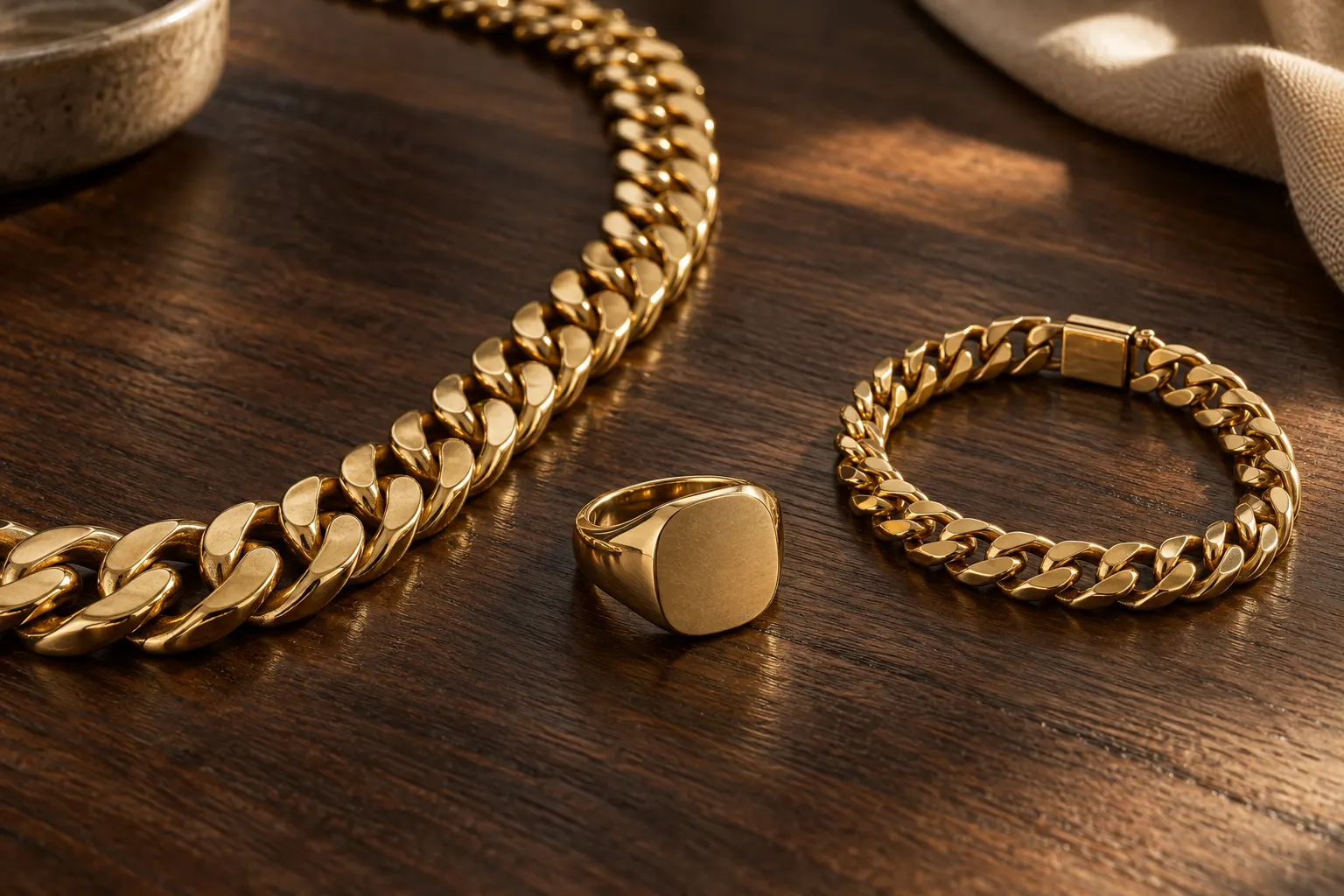
Signets were once considered a men's ring, but they're now just as popular with women. The real difference is proportion: women's signets tend to have small, delicate faces, sometimes in rose or white gold, sometimes with a small stone. Men's signets have wider faces and more weight. For more on men's pieces, see our men's gold jewelry guide.
Why are signet rings worn on the pinky?
The European tradition — especially in Britain — is to wear a signet on the little finger of the non-dominant hand, where it stays out of the way and was handy for sealing. There's no rule anymore: people wear signets on the ring or index finger too. Just remember that pinky sizes are much smaller than other fingers, so measure that exact finger using our ring size guide.
How heavy is a gold signet ring?
Signets are among the heavier rings because of their thick, solid face. Weight depends on face size, thickness, shoulder width (where the face meets the band) and ring size. A few ways to manage weight and price:
- An open (hollowed) back under the face cuts weight noticeably without changing the look from above.
- A smaller face — the difference between 10 and 14 mm is significant in grams.
- Deep reverse engraving needs a thicker face, which can mean more gold.
- 14K vs 18K — 14K is harder and more scratch-resistant; 18K is richer in color. The full comparison is in 14K vs 18K gold.
How to design a signet ring with AI
In the design studio, write a description such as: “oval signet ring in 14K yellow gold, 12 mm face, monogram of the letters N and D in deep engraving, brushed sides.” You'll get photorealistic designs in seconds and can refine them through chat — change the shape, add a stone or switch to rose gold. The more precise the description, the better the result; see how to describe jewelry to AI. Once you've chosen, request a personal quote on WhatsApp. The ring is handcrafted by expert goldsmiths at partner workshops in the Ramat Gan diamond exchange district, only after you approve the design, in about 2–3 weeks of production. Every step is laid out in our guide to ordering custom jewelry.
For more ring inspiration, browse our gold rings.